Chicago is known for, among other things, its wonderful museum district. The city has a little bit of everything for your spongy brain from historic cars to world-renowned art. One of those spots is the Griffin Museum of Science and Industry, which contains vehicles and science displays you won’t see anywhere else. One of the displays hanging from an upper floor is the majority of a Boeing 727. This isn’t a fake plane, either, but a real aircraft that used to serve United Airlines. But how the heck does a plane end up in a building in the Chicago metro area? The story of how it got there was pretty wild.
I’ve sometimes said that I live in the Chicago area, but that isn’t strictly true. I live about an hour and a half northwest of Chicago in a town nobody’s heard of. Because of this, if I want to enjoy the city’s incredible museum district, I have to make a whole day of it. Shockingly, I’ve been to the Museum of Science and Industry only twice in my whole life. I went last weekend during my birthday and the time before that was several years ago.
Thus, I’ve seen this plane only twice in my life. Only now, I’m a lot older and know a lot more about aviation than I used to. Suddenly, it hit me that holy crap, that really is an actual commercial airliner up there, and not a particularly small one, either. Mind you, this is in a giant stone building next to Lake Michigan. There are no runways nearby and it’s not like you’re getting a hefty commercial airliner through Chicago traffic. How did this thing get in here?

One of the crucial elements of this story is an airport that no longer exists.
Chicago’s Lost Fourth Airport
If you’re visiting Chicago by aircraft, you’re usually going to end up at one of three airports, all of which are a little outside of the city core.
If you’re pinching pennies on Frontier Airlines or Southwest Airlines, sorry: You’re likely landing at Midway International Airport and doing a long slog to get into the city. O’Hare International Airport is almost always your better bet, unless you’re a bit of a fancy pants riding in something sweet like a HondaJet, in which case your destination will likely be Chicago Executive Airport. There are other ways to get into the city via the air, such as the Vertiport Chicago FBO, but most people will fly in through one of those three locations.

Just two decades ago, there was a fourth option. If you visit Chicago today and get close to the lake, you might have seen what the city calls Northerly Island, even though it’s actually a peninsula. Confusingly, this peninsula has a randomly placed building (above, behind the Buell) and something that looks an awful lot like a control tower – but there isn’t an airport here. If you’ve played older installments of Microsoft Flight Simulator, you know where I’m going with this. Northerly Island used to be the site of Meigs Field.
A piece I wrote for the old site continues:
The story of Meigs Field begins with the peninsula that it was constructed on. In 1909, urban planner and architect Daniel H. Burnham published the Plan of Chicago. The book recommended improvements to the city like wider streets, parks, civic buildings, harbors and more. It even called for a highway system that circled the then vastly growing city.
Burnham died in 1912 before any part of his ideas became reality. One of his ideas called for the creation of an island that would serve as a lakefront park. By 1916, the co-author of his book, Edward H. Bennett, suggested that the site would be ideal for aviation. In 1920, ground broke on construction and the island was finished in 1925. The proposed airport didn’t get built, but the peninsula soon found itself to be the home of the Adler Planetarium and a World’s Fair. Flying boats reached Chicago by way of the peninsula.
The airport finally opened in 1948, Flying notes. And it was named the Merrill C. Meigs Field in 1950 after the aviation enthusiast and publisher of the Chicago Herald and Examiner of the same name.

For decades, Meigs served as an aviation hub in the downtown area. Fresh pilots got their wings from the peninsula, and that large building was a terminal. If you were wealthy enough to afford a plane ticket in the era before airline deregulation, you could board a flight at Meigs right there on the lake and fly to regional destinations around the Midwest. Meigs also served as a popular place for a few short-lived helicopter airlines, and was a place for emergency services to land before delivering either patients or organs to local hospitals.
Unfortunately, some saw Meigs as a sort of black mark on the city, and for good reason. Planes aren’t exactly quiet, and some folks understandably weren’t into hearing aircraft taking off day in and day out. The city also didn’t do itself any favors by raising landing fees, user fees, and parking charges. Towards the end, only people with enough money to overload a Cessna 172 with Benjamins could afford to put their wheels down there.
The demise of the airfield was plotted in the 1980s when, as Flying Magazine notes, Chicago Mayor Jane Byrne proposed getting rid of the planes and turning the field into a park. Mayor Byrne was halted by the fact that the field was the beneficiary of FAA grants, and each one guaranteed an airport would remain open for 25 years. Meigs received a grant in 1976, ensuring it would stay open until at least 2001.

Chicago’s 54th mayor, Richard M. Daley, wasn’t concerned with following procedure. In 1994, Mayor Daley announced that Meigs would become a park. To facilitate this, Mayor Daley instructed the Chicago Park District not to renew the field’s lease. That lease expired in 1996 and the Chicago Park District responded by painting large ‘X’ marks on the runway, signaling to aviators that the airport was closed.
Understandably, the state of Illinois, the FAA, pilots, businesses, emergency services, air traffic controllers, and more groups were all ticked off about this and kindly reminded Daley that Chicago was obligated to keep the airport open until at least 2001. Daley eventually backed down and reopened the airport. Then, 2001 came around and his plan to destroy the airport was dealt another blow when an organization representing Meigs took the issue to court and got a temporary restraining order.
Later that year, Chicago Mayor Daley and Illinois Governor George Ryan cut a deal that allowed O’Hare to expand so long as Meigs was allowed to live until 2006. Later, this would be amended to 2026.

… or so the official plan went. Mayor Daley, however, was tired of the darned airfield beating him at every turn, and he took dramatic action. At midnight on March 30, 2003, the Chicago Tribune reports, bulldozers escorted by the Chicago Police arrived at Meigs. A fire engine pointed a spotlight at the webcam at the Adler Planetarium so nobody would see what was about to go down, and Mayor Daley ordered the destruction of the airport. With nothing and no one to stop him, the big ‘X’ marks returned to the runway – but not with paint. The Xs were scribed into the pavement by the bulldozers’ blades, ensuring permanent damage to the runway that would prevent planes from using them.
In the aftermath, Flying Magazine writes, Mayor Daley first tried to explain away the destruction by saying it was done to protect Chicago from a 9/11-style terrorist attack, but the Department of Homeland Security wouldn’t back him up on that. Mayor Daley eventually admitted that he did it because going through the courts to seize the airport would have cost too much money and taken too much time. Remember, by that point, Mayor Daley had been wanting the airport dead for nine years and he had been stopped at every turn.
The planes that were stuck at the airport were allowed to take off from the intact taxiway and finally, after years of battle, Chicago got its peninsula park. Perhaps one of the coolest memories of Meigs is what happened a decade before its destruction.
Big Plane On A Little Runway

MSI’s Boeing 727-22 trijet carries registration N7017U. It was delivered new to United Airlines in 1964, the airline it would service its entire career with. N7017U was among the first 727s delivered to the airline and it had an important role.
Back in the late 1950s and the early 1960s, the easiest path to getting higher performance out of a jet aircraft was mounting four engines in pods under the wings. Likewise, a jet with four engines could legally perform long flights over oceans while the twinjets of the era were limited to flying no further than 60 minutes from the nearest airports they could divert to. However, quad jets were large and thirsty things.

The Boeing 727 was conceived as a bit of a compromise. Three engines meant United Airlines would get an aircraft powerful enough to operate at high-altitude airports. American Airlines would get a plane that wasn’t as thirsty as a 707. Eastern Airlines would get an aircraft that could fly longer routes over open water. Nobody got exactly what they wanted, but the 727 was designed to be a good all-round narrowbody for the day.
The Boeing 727 was good at its job, too, and 1,832 examples were constructed between 1962 and 1984. The 727 had such staying power that a handful of examples are still in service today as cargo aircraft while a handful more have been converted into private VIP aircraft. Many might remember the 727 for its screaming loud triplet of Pratt & Whitney JT8D-200 low-bypass turbofans. The 727 is so loud that, as of December 31, 1999, any 727 flying in U.S. airspace needs a hush kit to quiet it down. FedEx, which used to have a fleet of these beauties, sells the kit.


Noise really wasn’t a concern for N7017U. United Airlines began retiring its oldest 727s in the early 1990s. Normally, an aircraft lives a pretty sad life after decades of dutiful service. Often, planes get discarded at desert boneyards to either waste away or get scrapped. Maybe a historically significant aircraft will see its skin become luggage tags.
United believed the 727 was the first truly successful jetliner and because of this, the first ones were worth saving. So, some of its aircraft were spared an afterlife in a boneyard to live in museums. The Museum of Science and Industry became the recipient of N7017U in September 1992.
The first challenge was just getting the aircraft within close distance of the museum. O’Hare and Midway were way too far away, but Meigs didn’t really have a long enough runway. N7017U is 133 feet long with a wingspan of 108 ft and has a maximum takeoff weight of 169,000 pounds.

No aircraft of that size or girth had ever touched down at Meigs. The Boeing 727-100 had a Landing Field Length of 4,690 feet. Landing Field Length is the aircraft’s actual landing distance plus a safety factor. The calculation for this is landing distance times 1.667. The runway at Meigs was 3,900 feet long, but if you chop at least some of the safety factor out, the 727 can land there with room to spare. Pilots normally operated 727s out of longer strips, but this was a special flight.
To get around this, the 727 flew to O’Hare, and to prep for the aircraft’s final flight, it was loaded to be as light as possible. The aircraft didn’t carry more fuel than was needed or anything else that wasn’t required to get to nearby Meigs. On the flight deck that day was Captain B. C. Thomas, First Officer Bill Loewe, and Second Officer Greg Hammes. None of them had done anything like this before. United Airlines didn’t do short field landings and back then, United pilots didn’t even get to enjoy the fun of doing flybys for a crowd.
Captain Thomas said the crew had no real prep for this because none of them had ever flown a 727 as they would have to that day. But, all of them were skilled airmen, so they were happy to take on the challenge. On September 28, 1992, Thomas first performed a low fly-by for the crowd and media gathered at Meigs, and then he took the airplane in for its final landing. Thomas said he chose a super low landing speed of 115 mph and he aimed for the very beginning of the runway to get the most room he could achieve. Further, he wasn’t going to go for a soft landing, but to get all of the undercarriage down as fast as possible so he could throw on the brakes and throw out the engine reversers.
Captain Thomas battled a crosswind, but his effort was successful. Not only did he get N7017U down, but he stopped with plenty of room to spare. When a local Chicago TV station asked if the aircraft could take off again, Captain Thomas joked that sure, he’d give it a go if you chained the aircraft to something, let it run up to full power, and then cut the chain. What a legend.
That Belongs In A Museum
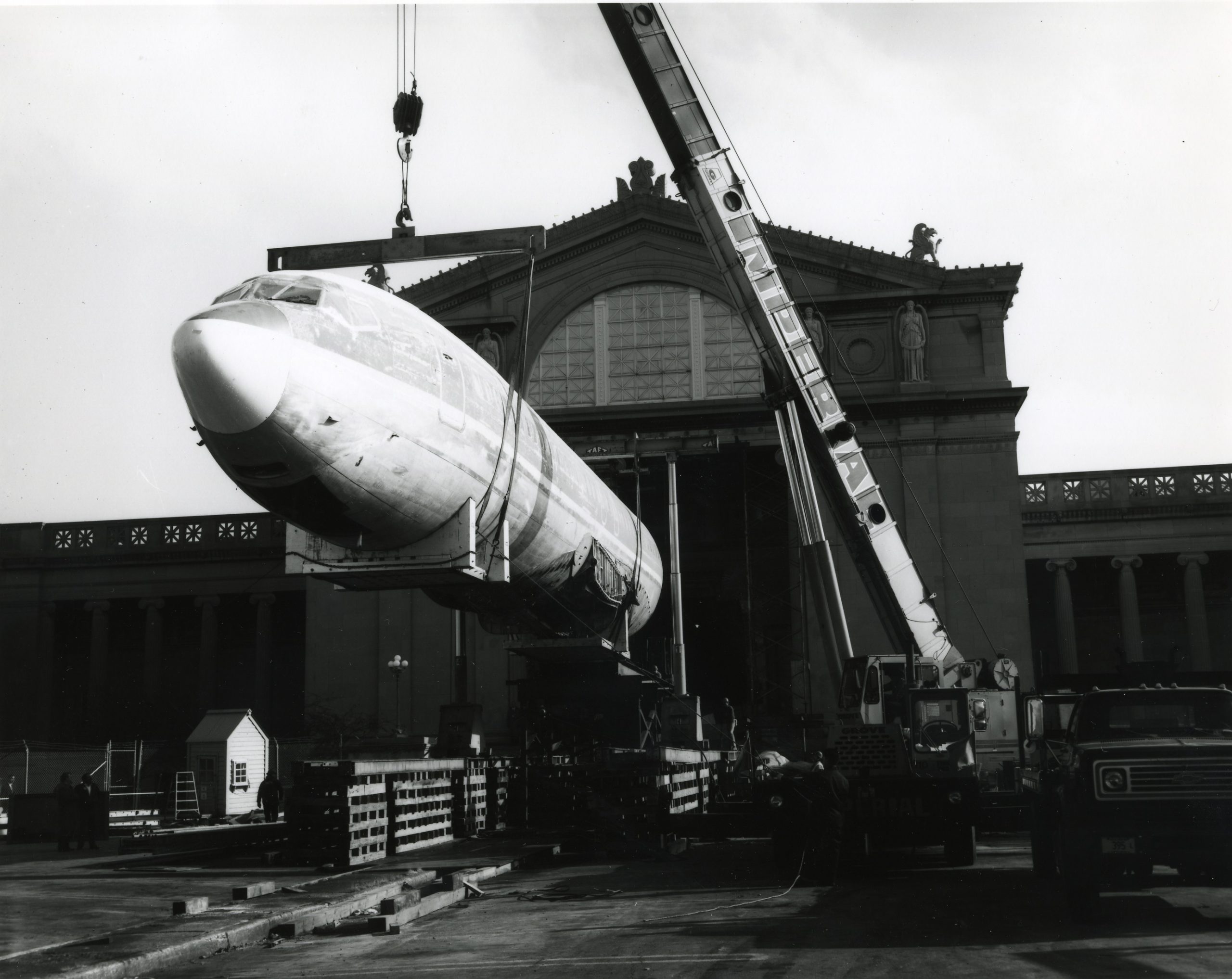
Really, landing the plane was probably one of the easier parts. Next, the plane was loaded onto a barge and floated to Indiana, where the aircraft was stored and prepped for its move to the museum. Then, it was floated back to Chicago, where the aircraft had to be tugged off of the barge, over a beach, across once-busy Chicago streets, and to the museum’s parking lot. This was a huge endeavor as Chicago’s street infrastructure wasn’t made for something of this size. City workers had to take down poles and clear a path wide enough for the intact airplane to fit.
Once the airplane got to the museum parking lot, another gargantuan effort began involving everyone from the government and private individuals to corporations, engineers, and construction firms. In its empty state, the jet weighed 41 tons.


Before it became a display, the plane would have to be gutted, cleaned, taken apart, and hoisted up. Then the museum itself had to be taken apart somewhat with one of the building’s iconic columns removed and the entrance expanded enough to fit a fuselage. The plane was lifted up by a crane as it sat on a special cradle, then it had to roll into the museum on a custom-built ramp.
Above is a screenshot from the video showing the work put into getting the plane inside. Yep, the plane was pretty much anchored to a floor of the building.
Once in the museum, the aircraft was painted in its classic 1960s livery and its hydraulic systems were replaced with air systems so that control surfaces could move as part of demonstrations. Then, engineers had to perform structural work to the museum so that the plane could be forever parked on a museum balcony.


The aircraft has been parked there ever since as a part of MSI’s ‘Take Flight’ exhibit. Emblazoned on the front of the aircraft is the name of Captain William Norwood, United’s trailblazing first Black pilot. The display has his inspiring story, too. If you’re lucky, you’ll find a United Airlines pilot volunteer at the display and they’d love to chat with you about aviation.
Step inside the aircraft and you will learn so much about the science and the mechanics of how airplanes work. If you don’t care about that, the aircraft is also a time capsule back to when seats weren’t tiny and flight decks didn’t have screens. It’s probably the closest I’ll come to ever sitting at the controls of one of these beauties.


If you’re ever in Chicago, I highly recommend a visit to MSI. To be clear, this isn’t a sponsored post. I blew a lot of my own money to go during the weekend. But, no matter how old you are, the place is just too cool.
This finally answers a question I’ve had for years. How on Earth do you get a plane into a beautiful stone museum in Chicago? Well, you just land it on a runway that’s too short, put it on a barge, cut it up, and cut the museum up, too. Then you just hang it from the floor. Easy peasy.

The post There’s A Giant Plane In This Chicago Museum And How It Got There Was Bonkers appeared first on The Autopian.
![Madonna – Who’s That Girl (1987/2020) [FLAC 24bit/192kHz]](http://imghd.xyz/images/2023/06/08/0093624951148_6004dceff9e1db710a9.jpg)


![VA – DVD-Audio Music Sampler Vol.2 (2003) [DVD-Audio ISO]](http://imghd.xyz/images/2026/05/13/4lSo1rN.jpg)